Bioreceptive Interface System

Turning ceramic into an active living interface.

BIS-01 transforms a ceramic surface into a modular bioreceptive interface that integrates plant support, water management, atmospheric harvesting and autonomous vegetation within a single system.

Functional demonstrator

A functional demonstrator validating BIS-01 as an active bioreceptive ceramic interface: internally irrigated, recirculated, plant-supporting and ultimately sustained by atmospheric water condensation.

BIS-01 functional prototype with ceramic module, plant, pump, reservoir and condensation unit.
Problem

Vertical greening fails when water management fails.

Irrigation problems cause up to 90% of vertical-greening failures. BIS-01 addresses this by transforming ceramic into a bioreceptive interface that reduces water demand, partially replaces substrate and minimises infrastructure and direct human intervention.

Instead of adding vegetation onto a surface, BIS-01 turns the surface itself into a biological support, hydration layer and modular architectural component.

90%of failures can be linked to irrigation problems
material roles: support, hydration and interface
1integrated ceramic system
repeatable modular scaling logic
Inspiration

From imagined green futures to material reality.

We were inspired by the gap between the green futures we imagine and the difficulty of making them real. Architects, designers and filmmakers fill buildings and cities with vegetation, yet these systems still depend on substrates, hydraulic infrastructure and maintenance.

We were also inspired by the Mediterranean and by an object as simple as the botijo, which uses the interaction between water and ceramic to modify its environment through the material’s properties. Building on that principle, BIS-01 develops a new application: a bioreceptive ceramic interface that hydrates itself from within and sustains plant life directly on its surface.

Interface

Bioreceptive design is embedded in the ceramic geometry.

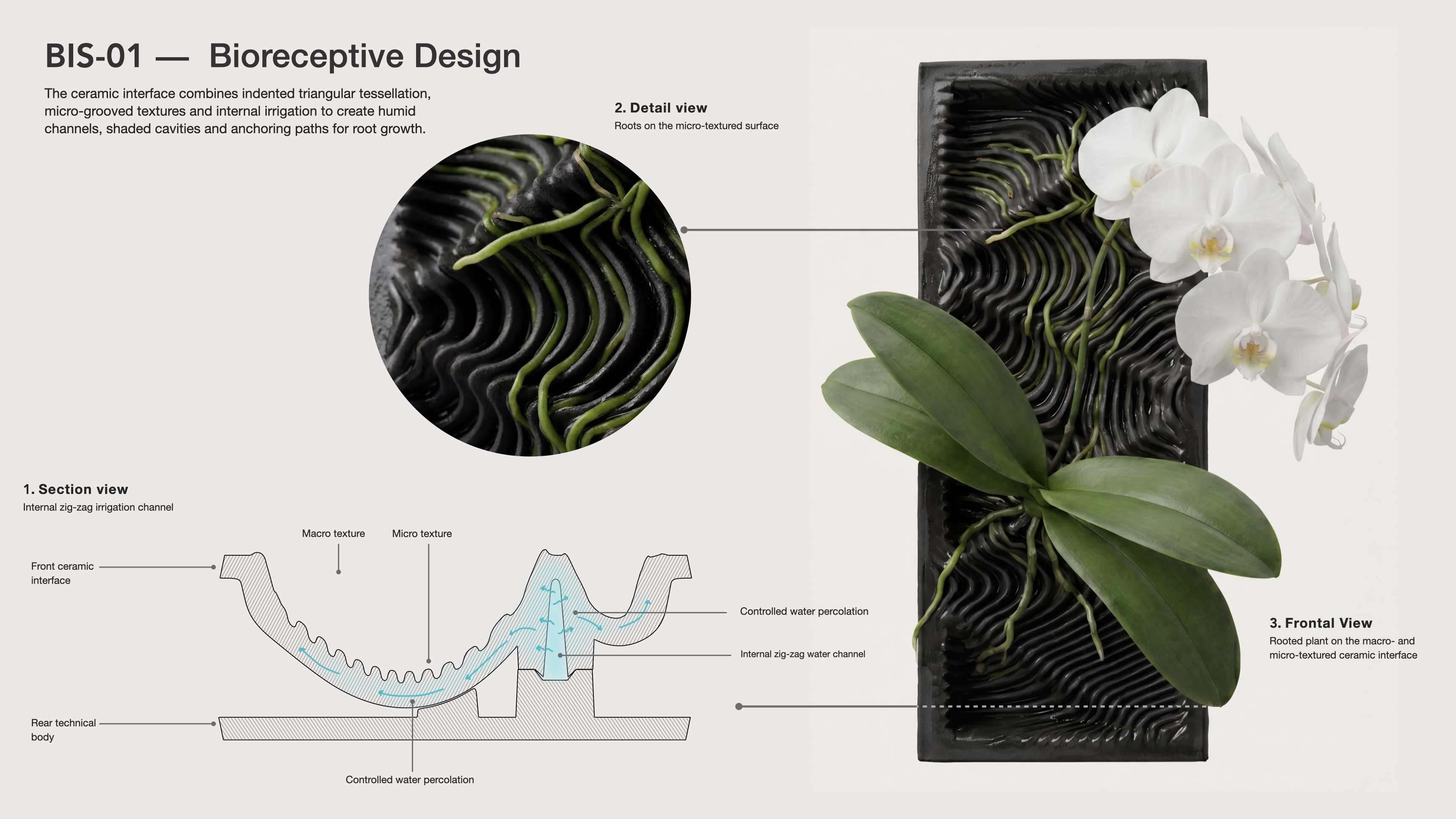
BIS-01 is based on bioreceptive ceramic modules whose surface combines indented triangular macro-geometries and micro-textures designed to increase root contact, retain moisture and generate favourable microhabitats. The ceramic itself becomes the growth interface, allowing roots to establish directly on its surface.

Bioreceptive ceramic interface showing roots, micro-texture, macro-texture and section view.
Module

The module hydrates from within.

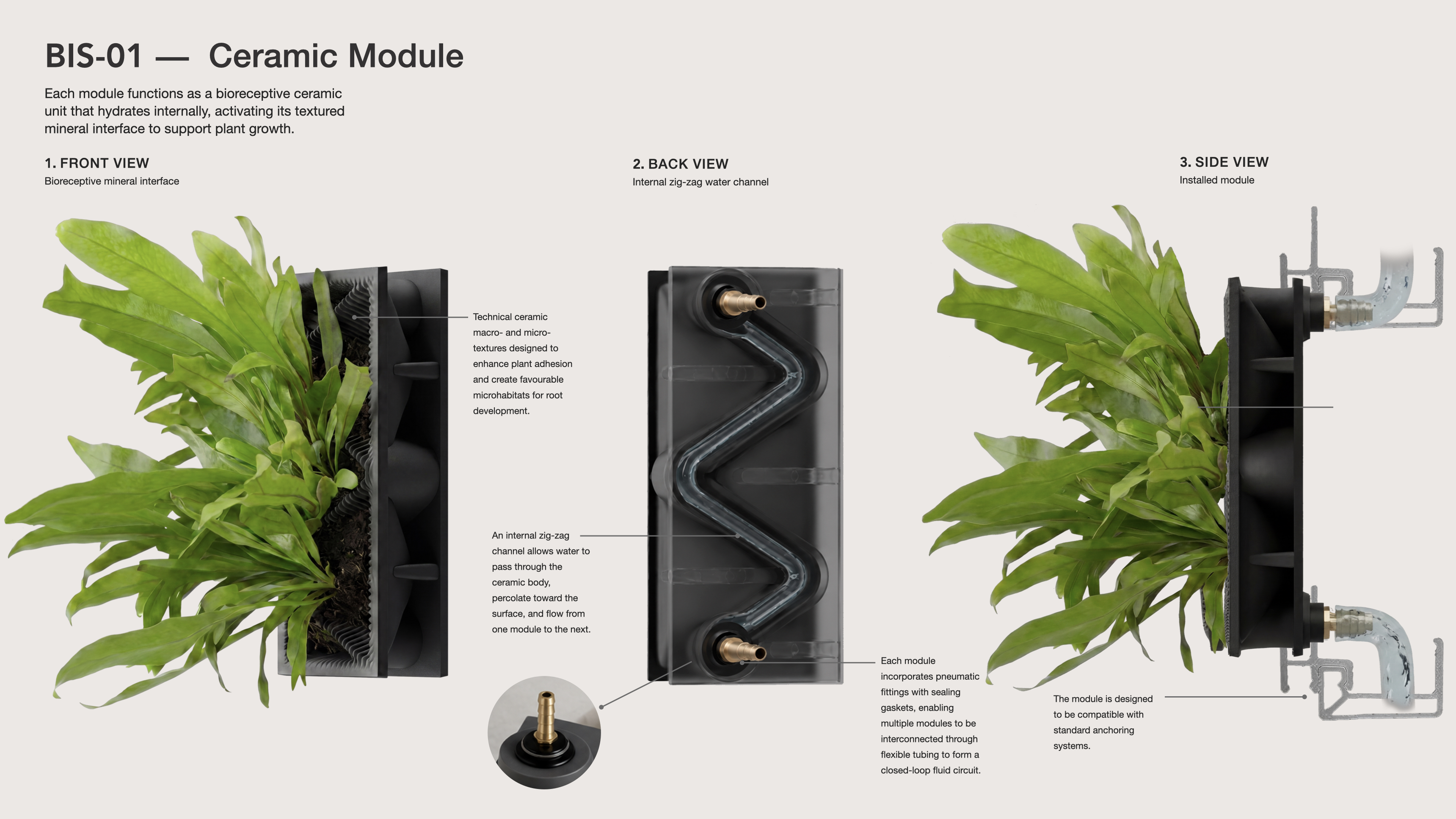
Inside each module, inlet and outlet irrigation channels can be interconnected to create scalable modular systems. Water circulates through these channels and percolates by capillary action through the material, distributing moisture evenly across the active surface where vegetation develops, without surface watering.

Ceramic module front, back and side views showing internal zig-zag irrigation channel and plant interface.
System

Low water demand makes atmospheric harvesting viable.

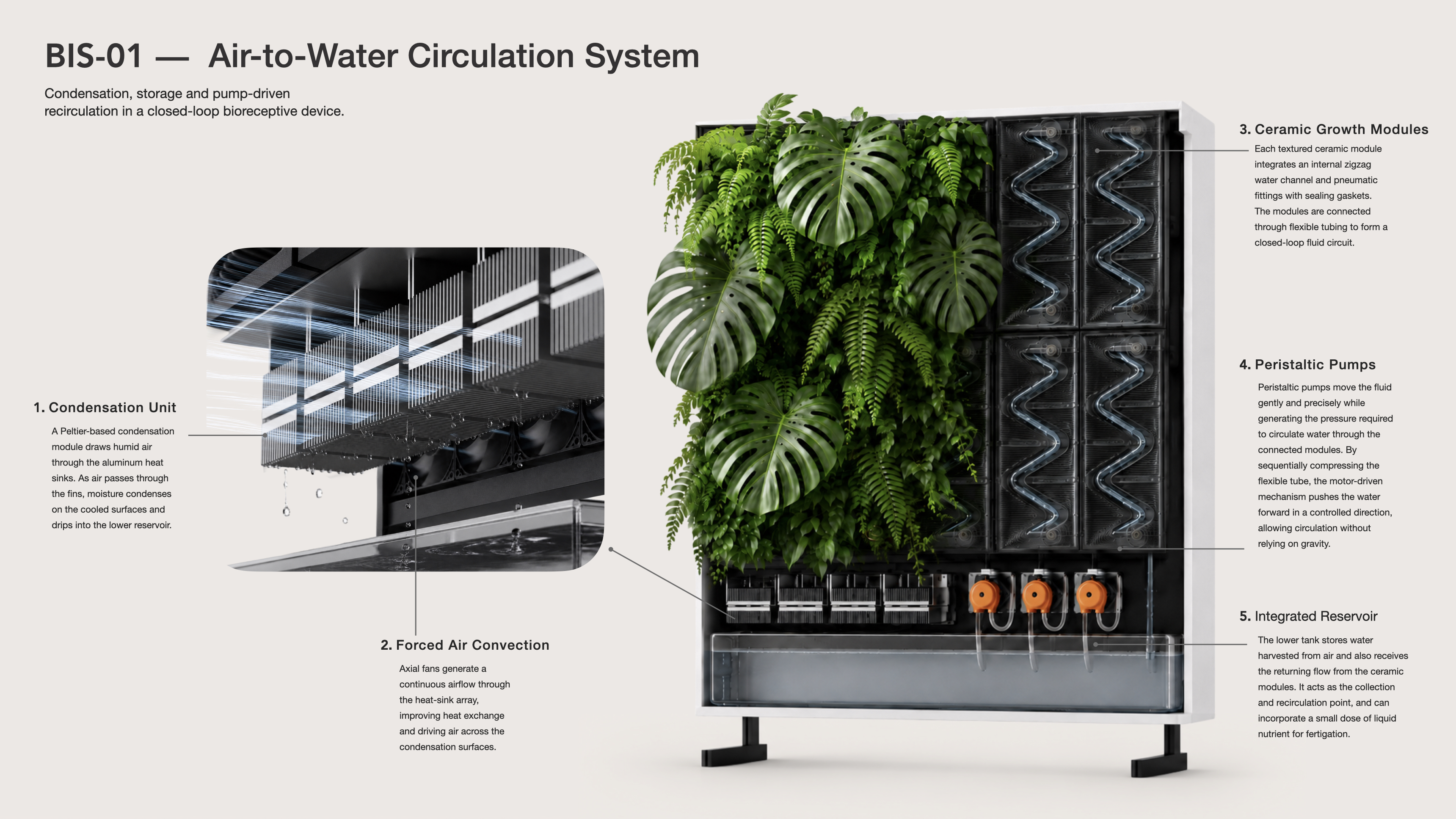
Water is supplied through atmospheric harvesting based on condensation. Fans force air across heat exchangers cooled by Peltier modules, where humidity is converted into liquid water and stored in a reservoir connected to the circuit.

Peristaltic pumps, sensors and a control unit automate circulation, monitoring and management. The condensation unit is not the invention alone: it becomes effective because the ceramic interface is designed to require limited water.

BIS-01 air-to-water circulation system with condensation unit, ceramic growth modules, peristaltic pumps and reservoir.
Design process

From mineral surface to active interface.

01

Tessellation

Triangular tessellation provided the geometric foundation by increasing exposed surface area per square metre.

02

Indentation

Three-dimensional indentations generate depth, shade and protected zones for vegetation.

03

Micro-texture

Micro-textures guide root growth, improve water distribution and support favourable microhabitats.

04

Internal irrigation

Channels distribute water through the material by capillary percolation, creating homogeneous hydration.

Difference

A new category of architectural interface.

Unlike conventional vertical gardens, BIS-01 does not add vegetation onto a surface: it transforms the surface itself into an active bioreceptive interface.

Its geometry combines indented macro-structures and micro-textures designed to promote root establishment, retain moisture and generate favourable microhabitats. Internal channels distribute water through the material by capillary action, hydrating only the active surface where vegetation requires it.

Together, these strategies reduce overall water demand. As a result, limited quantities of water obtained through atmospheric condensation can be sufficient to sustain the system.

Scalability

Designed to scale from object to architecture.

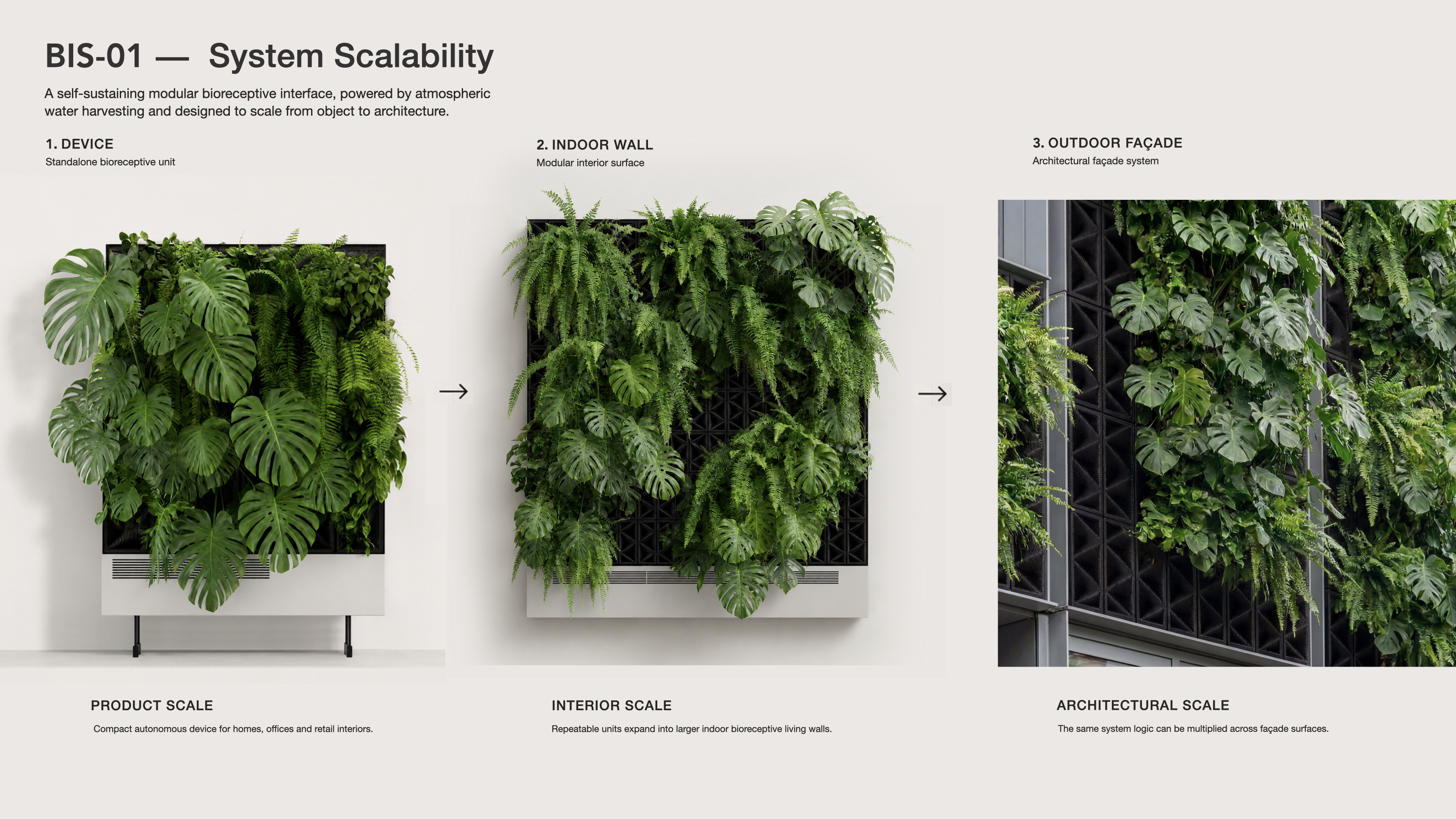
Self-generated water and automated management reduce dependence on external infrastructure and minimise human intervention. The result is a modular and scalable architectural interface capable of integrating biological support, water management and vegetation within a single functional surface.

BIS-01 system scalability from product scale to interior wall and architectural façade.
Future plans

With the technology protected through Spanish patent ES3009773B2 and international application WO2026078295A1, our goal is to build a deep-tech company focused on bioreceptive interfaces.

The next phase will validate biological performance, water and energy efficiency, rooting capacity and long-term autonomy across different species and environments. Our vision is a new generation of architectural materials capable of integrating vegetation, water management and biological support within a single functional surface, globally.

Contact

Contact us

For enquiries, collaboration, investment or pilot installations, send us your email and message.

Based in Valencia, Spain
Download PCT international publication
WO2026078295A1 · International patent publication PDF

This form is handled securely by Netlify Forms. Submissions can be forwarded to difusores.hidroponicos@gmail.com from the Netlify dashboard.